We've tried to ensure the information displayed here is as accurate as possible. Should there be any inaccuracies, we would be grateful if you could let us know at info@ipohworld.org . All images and content are copyright.
(Please click on the thumbnail for a bigger image.)
Arthur Vincent Aston CMG MC, First British Adviser For Perak
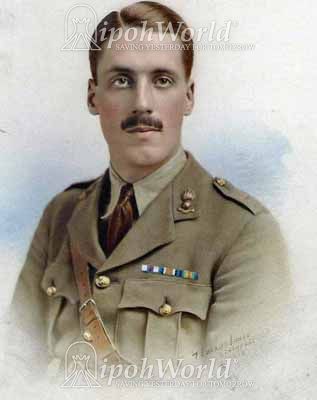
A V Aston born in 1896 in Chester, England was the first British Adviser for Perak after the post of British Resident of Perak was abolished. He was educated at King's School, Chester and Queen's College, Oxford and after service in the army during World War 1, joined the Malayan Civil Service in 1919.
In Perak in 1941 he held the posts of District Officer of Telok Anson (now Teluk Intan) and Chairman of the Kinta Sanitary Board, before being appointed Perak Adviser.
During the first World war he was decorated with the award of Military Cross (MC) and on 2nd January 1950 was invested as a Companion, Order of St Michael and St George(CMG).
During the Japanese occupation of Malaya he became an internee at Changi and Sime Road Prisons, Singapore, but survived the ordeal and in 1946 was appointed British Adviser for Perak. In 1948 he was reappointed Resident Commissioner of Penang. He retired from the Civil Service in 1951.
We are indebted to his grandson Mark Aston who has subsequently donated the following information:
"When the Japanese arrived in 1942, my grandmother caught one of the last ships out of Singapore with some of the family silver in a suitcase. The rest was buried in the garden of their bungalow - probably in Telok Anson, but my grandfather was appointed Resident in Malacca just before the surrender. When they returned after the war, in 1946, they discovered that the Japanese had dug a trench exactly where the silver was buried!
When the Astons returned to Malaya, and after two months as Acting Resident in Pahang Arthur was posted back to Ipoh, where he took over as Resident Commissioner for Perak. He immediately faced a wide range of problems. In August a campaign began to tackle the problem of rabid dogs in the Kinta Valley. By March the following year 1,500 had been destroyed, but Arthur nevertheless had to tell the Sunday Times staff correspondent in Ipoh that the situation was still deteriorating. In May the Straits Times reported his attendance at a badminton match where Perak was beaten three-two by a team from Selangor, which knocked them out of the Foong Seng Cup, leaving Selangor to face Penang in the semi-finals. Two months later, the former Chairman of the Kinta Sanitary Board had to admit to a press conference that owing to the rapid growth in Ipoh’s population, it was no longer possible for the Town Board to flush out the city’s drains on a large scale.
The Malayan Civil Service continued to rely on the help of locally recruited staff to do the job of administering the country. Each day Arthur would go through a wide range of files with his Malay secretary before checking on the work of his gardeners.
During the war, food had been in such desperately short supply that in 1943 the Japanese had begun a "Grow More Food" campaign. In what turned out to be a flawed initiative, huge areas of forest were cleared and the planting of cassava was encouraged. They chose this particular crop for two reasons: it grows extremely fast, and it requires very little energy or skill to cultivate it. Intensive cultivation of cassava does, however, denature the soil more completely than any other crop, and it rapidly renders the land good for nothing. This is exactly what it had done across the Kinta Valley.
Cassava plants have very large roots, which can be ground into a kind of flour. Water is then added to form a paste, and this is extruded through a sieve and chopped off into segments which are known as tapioca “pearls.” Tapioca is very high in starch, which makes it an ideal fuel for outdoor games at public schools, but it contains little in the way of proteins, minerals or vitamins. As a result those who depend heavily upon it often display signs of malnutrition.
In the years following the war, the British Government modified the Japanese "Grow More Food" scheme, encouraging the cultivation of more fruit and vegetables instead. As enthusiastic gardeners, Arthur and his wife Rita were keen to play their part, and the result was that the Malayan Pictorial Observer filmed Arthur in the garden of the Residency and praised “the lead given by the highest officials in growing as much of their own food as possible.”
Providing hospitality at short notice was one of a Resident Commissioner’s duties, and in March 1947 they were visited by the writer Compton Mackenzie, who was compiling material for a book on the role played by the Indian Army during the Second World War. Following a visit to the 23rd Indian Division, Mackenzie was driven through the rugged tin mining country of Perak towards Ipoh, “a most attractive town, well laid out with wide streets and good buildings.” After travelling for six months across the Middle and Far East, he had contracted bacillary dysentery. “Our host, the Resident Commissioner, A V Aston, was just the tonic I needed. He and his extremely kind and charming wife were hospitality incarnate. He was imprisoned by the Japs, but like everybody else in Malaya, does not utter a bleat about it. I woke at 4 and had a poor time, with the dysentery going strong. It was decided not to continue our journey until Saturday…. I am extremely lucky to find myself in a house where my host and hostess manage to make it seem a pleasure to have a guest with dysentery.” He dined with his “charming host and hostess” again the following night, before being driven on to Kuala Lumpur [excerpts from All over the place by Compton MacKenzie].
Arthur was chosen to represent Malaya at the wedding of Princess Elizabeth and Philip Mountbatten in Westminster Abbey in November 1947. He had planned to retire at this point, but he was prevailed upon to serve a further three years by the offer of the Resident’s job in Penang. Arthur and Rita arrived there on 2 May 1948 aboard the P & O liner SS Canton.