We've tried to ensure the information displayed here is as accurate as possible. Should there be any inaccuracies, we would be grateful if you could let us know at info@ipohworld.org . All images and content are copyright.
(Please click on the thumbnail for a bigger image.)
Sengalrayan Naidu
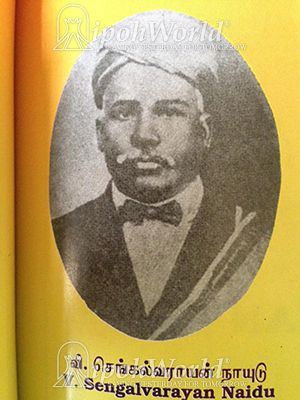
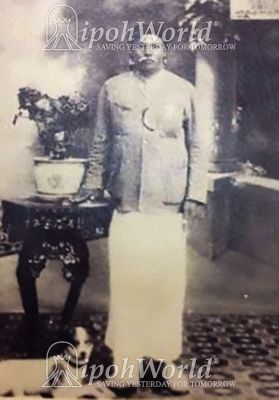
The photographs and details were generously provided by Sanjeev Kumar, great grandson and Shyamala Manoharan great granddaughter of Mr Sengalvarayan Naidu.
Sengalrayan was a wealthy businessman, land owner and developer; a pioneer in the setting up of Ipoh's early infrastructure. As a local philanthropist he contributed generously towards the Kinta Indian Association (KIA) which remains active until today. He also donated land for the setting up of a Hindu Cemetery in Buntong, Ipoh, which is also still in use today. His remains are buried there.
A religious man he donated both land and money for the building of both the Subramaniam Temple in Gunung Cheroh, Ipoh the Buntong Mariamman Temple, the latter which he helped to build.
As a contractor he was closely involved with Railway projects for the Perak State Railway and the later, Federated Malay States Railways. In particular he was involved in the building of railway track to Teluk Anson (Teluk Intan), several railway bridges and the first Ipoh Railway Station. In addition he was also involved in the construction of second Ipoh Court House; Shaik Adams Mohammedan Mosque; and Taiping Prison. He supplied Indian labour in the British Colonial era buildings and railway projects.
In 1907 he took the Perak State Government to court in a dispute centred on Ipoh’s People’s Park. This is reported in The Straits Times, of 15 January 1907, Page 2.
To mark his donation to Ipoh, a road (Lorong Sengalrayan) is named after him. It is situated behind the Education Department.