We've tried to ensure the information displayed here is as accurate as possible. Should there be any inaccuracies, we would be grateful if you could let us know at info@ipohworld.org . All images and content are copyright.
(Please click on the thumbnail for a bigger image.)
Newspaper Banner - The Malaya Tribune And John Victor Morais - A Brief History
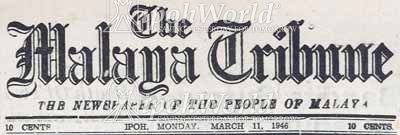
The Malaya Tribune was originally the idea of D C Perreau who, in 1913, was a regular contributor to the Daily Advertiser. He believed that there was a market for an English daily paper to cater for the English-educated locally-domiciled population, underpinned by a wealthy Chinese so there would be no need to be concerned with financial results of the venture. His argument was that while the Chinese, Malay and Indian communities already had their own paper, the English-language press was only designed to appeal to a European readership.
He passed the idea on to two friends; the talented and respected Dr Lim Boon Keng, a Queen's Scholar and legislative councillor and secondly, to Alexander W Westerhout a member of another well known local family.
On the 1st January 1914 the Malaya Tribune hit the streets for the first time in competition to the Straits Times. The Tribune was priced at five cents, which prompted a name, kerani's or clerk's paper. It's low pricing was to appeal to a broad Asian readership. The Sunday Tribune was then introduced on 21st May 1933.
In its early years, The Tribune often faced an uncertainty in its finances. It was also affected by high newsprint charges, but eventually the paper was acquired by the multimillionaire Loke Wan Tho of the Cathay Organisation, one of the most prominent film enterprises in South East Asia. Subsequently, with Victor Morais as editor, it became the most popular newspaper in Malaya with a circulation of about 13,000.
During the Japanese invasion and subsequent occupation, the Tribune's office was bombed and then taken over by the Japanese to print two of their local publications, The Yamato News and the Perak Shimbun. Victor Morais remained as editor.
The Malaya Tribune restarted on 15th October 1945, but having suffered from the war it did not get back the necessary circulation numbers to ensure its longevity and finally folded in 1951.
The paper was the training ground for many local journalists like T S Khoo, T H Tan and Leslie Hoffman. It also proved an invaluable experience for Sinnathamby Rajaratnam who worked at the paper as a cub reporter and later became Singapore's first minister for culture.
The scan shows the newspaper's banner for the Ipoh paper on Monday 11th March 1946, which by then cost 10 cents. This is believed to be in the original 1914 text style, but immediately after the end of the Japanese occupation the paper used a simple uppercase style as can be seen in another entry on this database.
Ipoh Remembered adds:
"And the Malaya Tribune was not an Ipoh paper: it was published in Singapore. An Ipoh office was opened in 1935 by Billy Paterson, a Scot who had come to Malaya in the early ’20s after finishing his newspaper apprenticeship in Dundee. Before joining the Tribune,Billy had worked with newspapers in Singapore – and in Penang (where he met his future wife, Edith).
The first Tribune office in Ipoh was on Brewster Road, an auspicious location only a few doors down from the FMS Hotel (and bar).
Billy Paterson later spent more than two years as a guest of the Japanese in Changi. He died in Penang in 1950.
Long ago I wrote a short note about the Tribune in Ipoh. If I have not already sent you a copy, let me know and I will do so (when I find it)."
John Victor Marais was not only a newspaper journalist and editor, but also a well known author of books about Malaysia, He was born in Trivandrum (the old name for Thiruvananthapuram), Kerala, southern India, but came to Malaya with his parents and was educated at Anderson School, Ipoh. Further education followed at the Regent Institute in London. He arrived in Malaya aboard the SS Rajula from Trivandrum Port and then Ipoh, in 1927
In 1938 he became the manager editor of the Malaya Tribune, a post he held until 1951 when the newspaper folded. This stint including publishing the Yamato News and Perak Shimbun for the Japanese as mentioned above. He then became editor of the Daily News, Manila (1951-1952), and chief sub editor of the Malay Mail, Kuala Lumpur (1955-1959), when he lived in Petaling Jaya with his wife, Gladys, and their five children.
Outside of his writing he also contributed much to the community. At one time or another he was:
Victor Morais passed away on March 6 1991 and the funeral was held at the Assumption Church, Petaling Jaya on March 7 1991.
Ipoh Remembered adds"
"Rajaratnam was minister for culture before Singapore gained its independence, but after independence he was given the key post of foreign minister, a role in which he excelled, serving in it until he was promoted to Deputy Prime Minister in the early '80s.
Victor was born in 1910 and came to Malaya in 1927.
And he was not accompanied by his parents: he came to Ipoh to join his older brother who was already a teacher at Anderson School.
Victor's wife Gladys died in 2015; she was more than ninety years old."
Ipoh Remembered also makes the foolowing comments about Victor Morais:
"The statement "In 1938 he became the manager editor of the Malaya Tribune" is not correct.
He was appointed managing editor of the Ipoh branch only.And yet it was quite a prize, and how he won it a mere six years after receiving his "School Certificate" is perhaps a tale worth telling — it involves our old friend John Woods of Cowdy & Jones.Outside of his writing he also contributed much to the community.In addition to the examples listed, one should mention that after the war the British appointed him to the Perak State Executive Council. I can write more about this if needed. (Again, your source may already have the details.)Victor Morais passed away on 6 March 1991, he was eighty years old."
To see a scan of a 1946 Malaya Tribune, click here.
To see a scan of one of the original Perak Shimbun issues in our possession, click here.
To read more about the Yamato News, click here.
To read a brief introduction to Loke Wan Tho and the Cathay Organisation, click here.